The Olympic Winter Games of 2026 features eight sports and fifteen disciplines (sport subdivisions), as per the official Olympic programme, with the anomalous sport being Ski Mountaineering.

Biathlon
Biathlon combines cross country skiing and rifle shooting. Athletes ski laps and stop to shoot prone and standing. Missed targets result in penalty loops or time penalties.
Circuit loop length is typically 2km to 2.5km depending on venue with total race distance ranging from 7.5 km sprints to 20 km individual events.
Traditional medal contenders include Norway, Germany, France and Sweden.

Skeleton
Skeleton is contested on the same track as bobsleigh but featuring a single athlete sliding head first, with no sleigh.
Track length once again ranges between 1200m and 1700m.
Traditional medal contenders include Germany, Great Britain and Latvia.

Ice Hockey
Ice Hockey is a team sport played on a 60 m by 30 m rink. Games consist of three 20 minute periods.
Men’s traditional contenders include Canada, Sweden, Finland and USA.
Women’s traditional contenders include Canada and USA.

Luge
Luge athletes compete feet first on a sled, navigating an artificial ice track, comparable to skeleton.
Track length ranges from 1000m to 1700m. Speeds are known to exceed 130 km per hour.
Traditional medal contenders include Germany, Austria and Italy.

Ski Mountaineering (Skimo)
Skimo was approved by the IOC as an additional sport specifically for Milano Cortina 2026.
Its Olympic status applies to this edition only and is not automatically guaranteed for future Games.
Skimo combines uphill skinning (climbing in skis), boot pack sections (Hiking on food) and skiing descents with multiple transitions.
Sprint courses are typically 500 m to 800 m in total length with vertical gain. Mixed relay formats use short technical laps with repeated transitions.
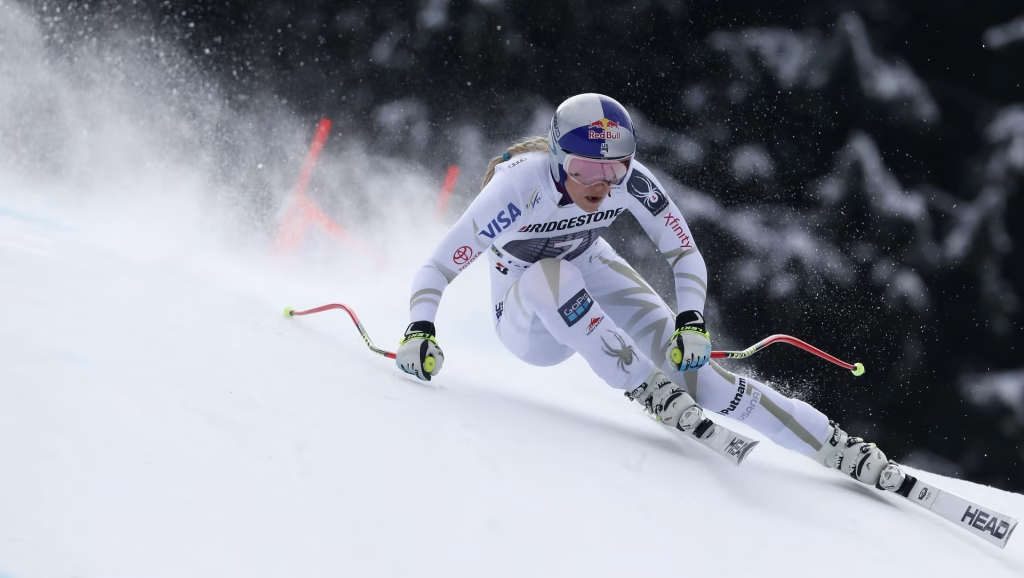
Alpine skiing includes downhill, super-G, giant slalom and slalom.
- Downhill is the fastest event. Courses run 2–3.5 km with vertical drops over 800 m and the fewest turns.
- Super-G is slightly slower, with more gates and tighter turns. It’s down one run.
- Giant slalom is more technical, with medium-length courses and set rhythms (turn pattern). Two runs decide the result.
- Slalom is the shortest and most technical, with tight gates and rapid turns. Two runs count.
Traditional contenders include Switzerland, Austria, Norway, Italy and USA.

Bobsleigh
Bobsleigh involves teams pushing a two person or four person sled before completing a timed descent.
Tracks are artificial ice courses measuring approximately 1200m to 1700m.
Traditional medal contenders include Germany, USA, Canada and Switzerland.
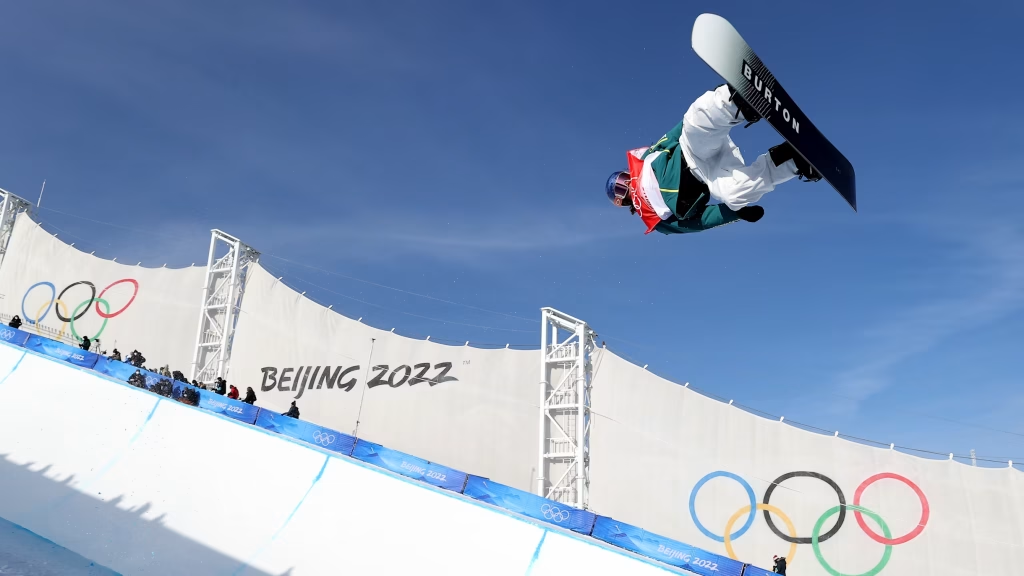
Snowboarding containes several disciplines.
- Halfpipe is held on a 150–170 m U-shaped pipe, judged on amplitude, trick difficulty and execution.
- Snowboard Cross runs on roughly 1 km tracks with jumps, rollers and banked turns, where riders race head-to-head.
- Slopestyle is judged on a multi-feature course combining rails and jumps, with scores based on difficulty, variety and execution.
- Big Air is a single large jump format, judged on trick difficulty, amplitude and landing control.
Traditional contenders include USA, Canada, Japan, Austria and Australia.

Curling
Curling involves two teams sliding granite stones towards a target area, or house. Scoring is based on stone proximity to the centre of the house after each end. Ends being rounds within which 16 stones are curled, 8 per team, 2 per player.
The sheet measures 45.7m from back line to back line. Matches are played over ten ends, eight in mixed doubles.
Traditional medal contenders include Canada, Sweden, Great Britain and Switzerland.

Cross Country Skiing is contested on looped courses measuring 2.5 km to 5 km. Race distances range from 1.5 km sprint events to 50 km mass start races.
Race distances range from 1.5 km sprint events, often staged in knockout heats, to 50 km mass start races. Events are split between classical and freestyle techniques.
Traditional contenders include Norway, Sweden and Finland.

Ski Jumping is contested on normal hill around 90 m and large hill around 120 m configurations. Judged on distance relative to the K-point (market), style scores from judges, and wind and start gate compensation, with the highest total score winning.
Traditional contenders include Norway, Germany, Poland, Japan and Austria.

Nordic Combined brings together ski jumping and cross-country skiing in a two-stage format.
Jump scores for distance and style are converted into time gaps, with athletes starting the cross-country race accordingly under the Gundersen method; the first to cross the finish line wins overall.
Traditional contenders include Norway, Germany and Austria, all of which maintain strong development pipelines in both components of the sport.

Freestyle Skiing includes several disciplines.
- Moguls is contested on a 200–270 m course of steep moguls, judged on speed, turns and aerial tricks.
- Ski Cross takes place on roughly 1 km tracks with jumps, rollers and banked turns, where four athletes race head-to-head.
- Halfpipe is held on a 150–170 m U-shaped pipe, judged on amplitude, difficulty and execution of aerial tricks.
Traditional contenders include Canada, USA, France and Switzerland.

Skating
Figure Skating takes place on a 60 m by 30 m rink and combines technical elements with judged performance. Competition includes short programme and free skate segments.
Traditional contenders include Japan, USA, Russia (subject to IOC eligibility) and Canada.
Speed Skating takes place on a 400 m oval. Distances range from 500 m to 10000 m, including team pursuit.
The Netherlands has generally been the dominant nation in long track speed skating.
Short Track Speed Skating takes place on a 111.12 m oval marked inside a standard rink. Races involve pack positioning and elimination formats.
Traditional contenders include South Korea, China and Canada.
